


How Is an Extruded Aluminum Enclosure Made?
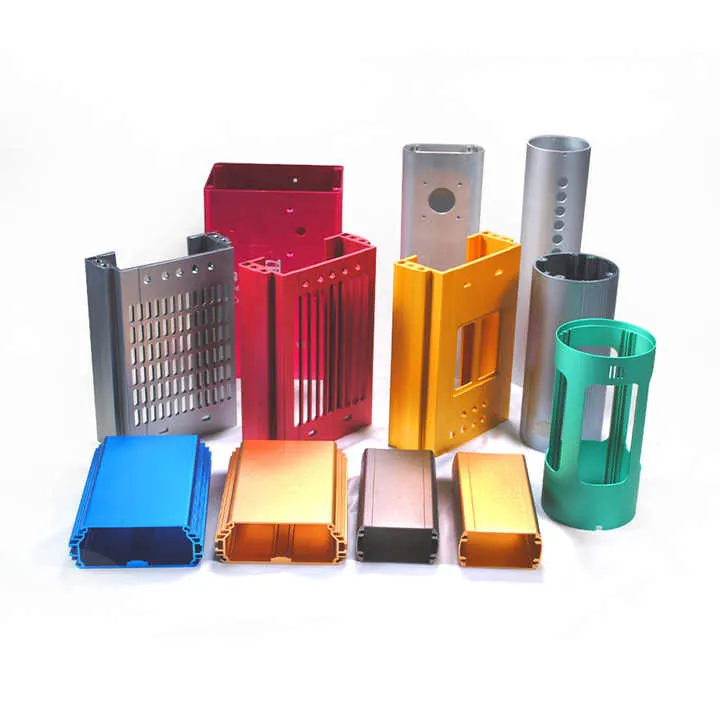
An extruded aluminum enclosure starts life as a custom cross?section profile. Here’s how it transforms into a fully featured housing:
What Are the Key Extrusion Steps?
-
Billet Preparation
High-quality aluminum billets (e.g. 6063?T5/T6) are heated to 400–500?°C to soften them. -
Die Setup & Ram Extrusion
A steel die, matching your enclosure’s internal channels and wall geometry, is preheated and inserted into the extrusion press. A hydraulic ram pushes the heated billet through the die, creating a long continuous profile . -
Cooling & Straightening
The emerging section is cooled (air or water), then stretched straight to correct twists caused during extrusion. -
Cutting to Length
It’s cut to precise lengths, often slightly over to allow for later finishing . -
Heat Treatment/Aging
If needed (e.g. for T6 temper), extrusions are aged in an oven to achieve targeted strength.
How to Integrate CNC After Extrusion?
Once you have uniform extruded lengths, you can add CNC machining to customize your enclosures:
- End-face machining: create flat surfaces, mounting holes, countersinks, or threaded holes.
- Side machining: cut ports, slots, panels, or EMI venting.
- Sub-assembly features: machine recesses for fasteners or connectors.
For example, many extruded side rails are CNC-machined at the ends to accept self?clinching nuts or tapped holes for front and back panel attachment .
What Finishing Processes Are Used?
After CNC, enclosures often get protective and cosmetic finishes:
- Anodizing (sulfuric or hard) – adds corrosion resistance, color, and wear resistance .
- Chemical film conversion (Alodine/Chem-Film) – improves paint adhesion and provides EMI protection .
- Powder coating – durable, colorful, and thicker than paint; ideal for rugged enclosures .
- Mass finishing – e.g. vibratory tumbling to deburr and polish all exposed edges.
Many manufacturers also offer custom graphics like laser etching or screen printing on panels .
How to Design for Ease of Assembly?
Design choices at the extrusion and CNC stage can drastically simplify assembly:
- Integrated mounting flanges: e.g. slotted rails for easy panel mounting .
- Pre-tapped holes: or CNC-machined pads to accept screws or self-clinching nuts.
- T-slots or channels: allow bolts and mounts to slide into place.
- Symmetrical profiles: minimize fixture setup and CNC programming.
- Chamfered edges: easing the insertion of panels and gaskets.
A common strategy: CNC-machine threaded #6 screws into the ends, then slide on pre-cut panels which lock in place—no brackets or extra fasteners needed .
Summary Table
| Step | Key Details |
|---|---|
| Extrusion | Heat billet → ram through die → cool/stretch → cut to length |
| CNC Integration | Machine holes, ports, tap ends |
| Finishing | Anodize / chem-film / powder coat + deburring |
| Assembly Design | Use mounting flanges, pre-tapped holes, T-slots, symmetrical extrusion |
Quick Quiz
Extruded aluminum enclosures always require CNC machining.False
Basic enclosures can be built with simple cuts, but CNC adds custom features for specific applications.
Designing mounting flanges into the extrusion simplifies assembly.True
Built-in flanges allow panels and fasteners to install without extra brackets, reducing parts and time.
Conclusion
Extruded aluminum enclosures combine automated production with custom flexibility. You design a profile for extrusion, cut it to length, CNC critical features, apply protective finishes, and incorporate snap-in fixtures and mounting features right into the design. The result? A robust, lightweight housing that’s efficient to build and easy to assemble.


