How much does it cost to buy custom aluminum extrusions?

Imagine you’re designing a new product and need a bespoke aluminum profile—but pricing is unclear and margins are tight.
The cost of a custom aluminum extrusion depends on tooling or die investment, raw material choice, production volume, finishing, and logistics.
Now let’s examine each question in depth so you can plan your budget and choose suppliers smarter.
What determines custom extrusion price?
If you don’t understand what drives cost, you risk being surprised by a high quote.
Key drivers include the cost to create the custom die, the price of raw aluminum, production labour and overhead, surface finishing and secondary operations, and the order’s logistics.
When I work with clients I highlight the five major cost components:
1. Die and tooling costs
For custom profiles a new die often must be made from scratch. For example, simple dies might cost a few hundred dollars, whereas dies for large or complex profiles can cost thousands.
The die cost often gets amortised across production volumes.
2. Raw material price
The aluminum billet or alloy choice has a direct impact. Market volatility, alloy grade (standard vs high‑performance) and source all matter.
3. Labour, production overhead & finishing
Production time, machine setup, changeovers, scrap—all add overhead. Then finishing operations (for example anodising, powder coating, CNC machining) raise cost further.
4. Profile complexity & size
Large cross‑sections, multiple cavities (hollow profiles), thin walls, and asymmetry all make tooling more expensive and slow production.
5. Logistics, tooling amortisation & order size
Shipping, import duties, packaging, plus spreading the fixed costs of tooling over a smaller quantity all influence the final cost.
Table: Typical cost factors
| Élément de coût | What it affects |
|---|---|
| Die/tooling | Up‑front investment, unit cost impact |
| Matières premières | Baseline raw cost per kg or per metre |
| Labour & production | Press time, machine usage, wastage |
| Finishing / secondary ops | Surface quality, machining, heat‑treat |
| Order size & logistics | Fixed cost spread, shipping, duties |
In one project I handled, a tooling cost of roughly US$1,500 was applied to an order of only 2,000 kg. That tooling cost alone added about US$0.75 per kg even before material or finishing. With a larger volume the overhead per kg fell significantly.
Die/tooling costs only matter for very large orders.Faux
Even small orders must absorb the one‑time die cost, so tooling matters for any custom profile.
Raw material price fluctuations can change extrusion cost significantly.Vrai
Because aluminium is a traded commodity, changes in its price affect the final unit cost.
Why order volume affects final cost?
Ordering a small run versus a large volume run changes your cost structure dramatically.
Higher volumes allow fixed costs (like tooling and setup) to be spread over more units, reducing cost per piece and improving economies of scale.
Here’s how volume matters in practice:
Fixed vs variable costs
Fixed costs like tooling and machine setup are the same regardless of how many units you make. Variable costs (material, finishing, shipping) scale with quantity.
With a low quantity, fixed costs dominate the per‐unit price; with a high quantity fixed cost becomes a smaller part of unit price.
Order size effect
If you order 500 metres of profile vs 5,000 metres, the tooling cost spread across the larger quantity means a much lower cost per metre.
Many suppliers offer lower per‑unit pricing once certain volume thresholds are hit.
Impact on production efficiency
Larger orders often justify dedicated runs, fewer changeovers, better yield and less waste. That improves supplier efficiency which translates to lower cost for you.
Table: Example of volume effect
| Volume des commandes | Total Fixed Cost (tooling + setup) | Approx. Fixed Cost per kg |
|---|---|---|
| 1,000 kg | US$1,500 | US$1.50/kg |
| 10,000 kg | US$1,500 | US$0.15/kg |
| 50,000 kg | US$1,500 | US$0.03/kg |
From experience: when we shifted a client from a 1,000 kg order to a 10,000 kg order, the cost per metre dropped by around 30%.
Volume has no effect because material cost dominates.Faux
While material cost is important, fixed costs like tooling and setup significantly affect unit cost, especially at low volumes.
Larger order sizes lead to lower unit cost for custom extrusions.Vrai
Because fixed costs are spread over more units and production becomes more efficient.
How to compare custom supplier quotes?
Getting quotes is one thing—but comparing them properly is another. You must look beyond the headline price.
You should compare how the quote breaks down: tooling cost amortisation, alloy grade, finishing specs, tolerances, shipping/packaging and assumed volume.
Here are practical steps for comparing supplier quotes:
1. Break down the quote
Ask the supplier to provide a breakdown: tooling/die cost, material cost (kg or metre), press cost, finishing cost, shipping/logistics. Transparency helps you see what drives cost.
2. Confirm technical specs match
Check that alloy grade (e.g., 6063‑T5 vs 6061‑T6), surface finish (anodise thickness, colour), tolerances, straightness and length all match across quotes. Differences here easily cause price swings.
3. Volume and amortisation assumptions
Check what volume the quote assumes and how tooling cost is spread. A quote based on 500 kg is different from one based on 10,000 kg even if all else seems equal. Ask: “If I increase the order to 5,000 kg, what’s the unit price?”
4. Check hidden costs
Look for shipping, import duties, packaging, inspection/testing, scrap losses. Some quotes may exclude these plus longer lead times which may cost your project.
5. Supplier capability and references
Choose suppliers with proven tooling experience, quality control and track record. A low price is worthless if quality or lead time is poor. Evaluate: ISO certification, press size capability, experience with your alloy/size.
In one case I compared two suppliers for identical profile. Supplier A quoted US$2.50/m on 2,000 m order. Supplier B quoted US$2.30/m but assumed a 10,000 m order and excluded finishing. Once adjusted, Supplier B’s real cost came to US$2.80/m.
All quotes for custom extrusions are directly comparable without clarification.Faux
Quotes may hide differences in specs, volume assumptions, tooling amortisation or finishing, so need detailed breakdown.
Breaking quotes into components (tooling, material, finishing) helps you compare accurately.Vrai
This gives transparency and highlights cost drivers and differences between suppliers.
Can simplified profiles reduce pricing?
The design of the profile plays a major role in cost. Simplifying geometry often reduces tooling cost, production time and scrap risk—thus lowering overall price.
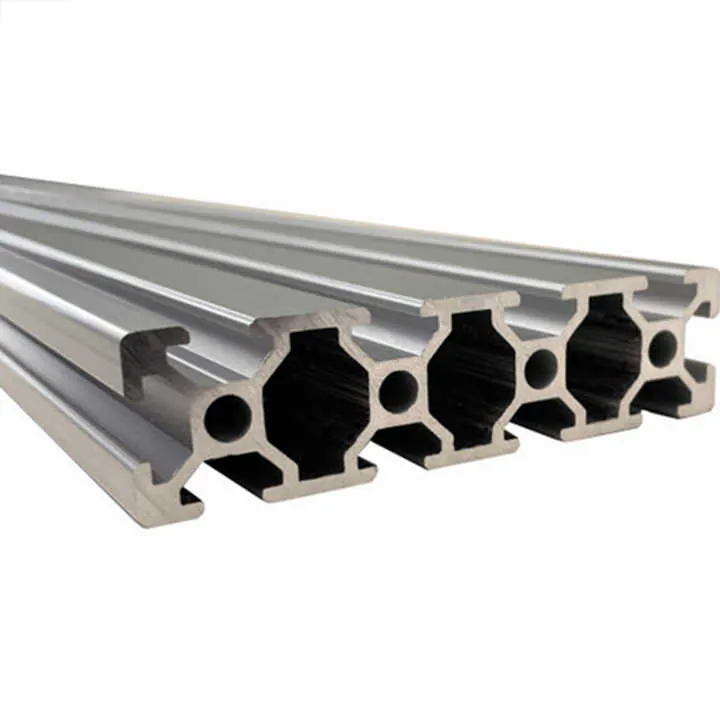
Yes—by designing simpler, more symmetrical profiles with thicker walls and fewer cavities, you can reduce die cost, improve flow, minimise waste and therefore reduce unit cost.
Here’s how it works in practice:
Design for manufacturability (DFM)
- Avoid very thin walls or extremely narrow legs inside the profile—they complicate tooling and flow.
- Use symmetrical cross‐section where possible—this helps metal flow evenly and reduces die stress.
- Reduce unnecessary internal cavities or features—the fewer voids the easier the die and the lower the cost.
- Standardise wall thickness and minimise abrupt transitions or undercuts—they add cost because tooling must handle them.
Impact on cost
Simpler shape → lower die cost → faster production → less waste → lower unit cost. For example, I had a client whose profile originally had three internal cavities. By redesigning to a singl