Comparaison de la conductivité thermique de l'extrusion d'aluminium ?

Some aluminum extrusions run too hot — causing failures in lighting, electronics, or cooling systems. This often traces back to poor alloy or shape selection.
Thermal conductivity in aluminum extrusions depends on alloy type, profile shape, surface treatments, and production quality. Choosing the right combination improves heat dissipation.
Let’s compare alloy conductivity, profile impact, test practices, and surface treatment effects on thermal performance.
Which alloys offer the highest thermal conductivity?
Aluminum is a naturally good heat conductor, but not all alloys behave the same. Alloying elements change conductivity significantly.
Alloys in the 1000 and 6000 series, especially 1050, 6063, and 3003, offer higher thermal conductivity than high-strength 7000 or 2000 series alloys.
Thermal Conductivity of Common Extrusion Alloys
| Alliage | Typical Conductivity (W/m·K) | Description |
|---|---|---|
| 1050 | ~237 | Nearly pure aluminum |
| 6063-T5/T6 | ~200–218 | Great balance for heat sinks |
| 3003 | ~190–210 | Often used in HVAC applications |
| 6061-T6 | ~150–170 | Strong, moderate conductivity |
| 7075-T6 | ~130–150 | High strength, low conductivity |
Alloys with fewer alloying elements (like silicon, magnesium, or copper) scatter fewer electrons, resulting in better thermal conduction. This is why 6063 is preferred for LED housings or electronics.
6063 aluminum has higher thermal conductivity than 6061 aluminum.Vrai
6063 contains fewer alloying elements, allowing more free electron movement and higher conductivity.
7000 series alloys are always the best choice for thermal conduction in extrusions.Faux
7000 series alloys prioritize strength and typically offer lower conductivity than 6000 or 1000 series.
How do profile shapes impact heat flow?
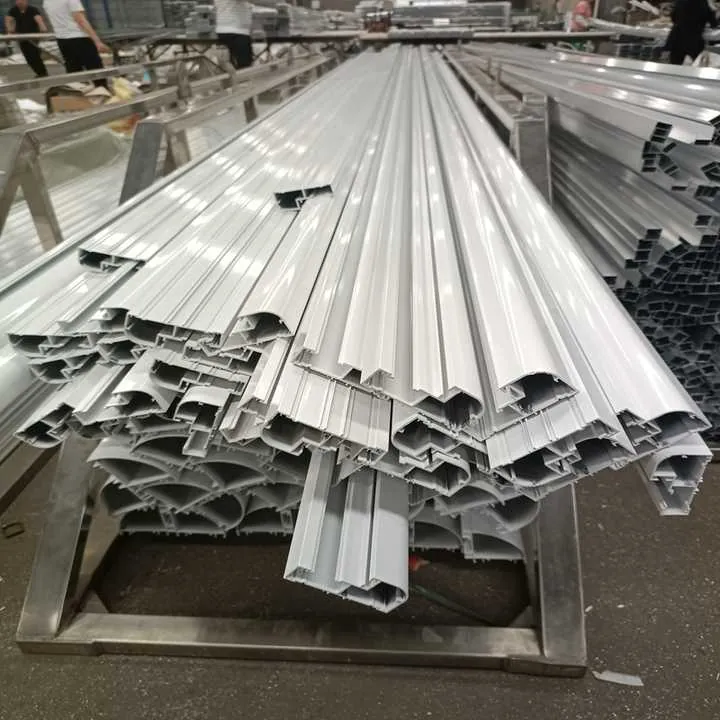
Heat conduction isn’t just about material — the shape of an extrusion controls how fast and how evenly heat moves.
Profiles with large surface area, thin fins, or internal channels enable better heat dissipation by increasing airflow and contact area.
How shape affects heat performance
- Thin fins increase surface area and allow air movement.
- Hollow chambers help with fluid flow and even heat distribution.
- Wide flat bases distribute heat across devices.
- Consistent wall thickness prevents hot spots or uneven flow.

For example, a solid square bar of 6061 conducts worse than a 6063 finned heat sink under forced air, despite similar mass. Why? Because fins accelerate convection.
Design tip:
Use symmetrical designs with air flow paths and enough spacing between fins. If using fluid cooling, internal channels can double performance.
Profile design affects heat dissipation even if the material is the same.Vrai
Finned or hollow designs increase the ability to transfer heat to air or fluids, improving performance even without changing the alloy.
Are tests standardized across extrusion suppliers?
Not all extrusion suppliers test for thermal conductivity, especially when parts are used for general structural purposes.
Thermal conductivity testing is not fully standardized across suppliers. Many rely on published alloy data or customer-specific test requests.
Most producers use alloy datasheets and ensure proper chemistry through certification, but:
- Few test thermal conductivity per batch
- Some test thermal resistance on finished products
- Customers requiring thermal parts must specify test conditions
There are no globally enforced ASTM or ISO standards for thermal testing of extruded profiles, though methods like ASTM E1952 ou ISO 22007 are used in R&D or high-performance applications.
When is testing needed?
- Dissipateurs thermiques pour LED
- Liquid-cooled structural profiles
- Automotive battery housings
- HVAC coil fins
If your extrusion must transfer heat reliably, request a sample test or simulation under load.
Thermal conductivity is routinely tested in all aluminum extrusions.Faux
Unless specified by the client, most suppliers rely on known alloy values without testing each batch.
Customers with thermal demands should request specific test reports or simulations from the supplier.Vrai
Not all extrusions are tested for conductivity, so thermal-critical applications need extra validation.
Can surface treatments reduce conductivity levels?
A good alloy and great shape can still underperform — if the surface traps heat.
Yes, coatings like anodizing, painting, or powder coating reduce thermal conductivity at the surface. The thicker the coating, the more heat resistance.
Anodized aluminum has a hard alumina layer (Al₂O₃) with conductivity as low as 25–30 W/m·K. Compare that to aluminum’s ~200+ W/m·K. While anodizing protects against corrosion and wear, it insulates thermally.
Surface treatment impact on heat flow
| Traitement de surface | Effet thermique |
|---|---|
| None (bare aluminum) | Best conduction |
| Thin anodizing | Slight reduction |
| Thick anodizing | Moderate reduction |
| Revêtement en poudre | Major reduction |
| Painted surfaces | Moderate to high impact |
For non-critical parts, anodizing is fine. But for heat-intensive devices (like LED cooling plates), raw or lightly finished surfaces perform better.
Designers often strike a balance: anodize only the areas not in thermal contact or use conductive surface coatings like black oxide with better emissivity.
Anodizing aluminum increases corrosion resistance but reduces surface heat conductivity.Vrai
The anodized layer is a ceramic with lower conductivity than bare aluminum, acting as an insulator.
Powder coating improves thermal conductivity of aluminum extrusions.Faux
Powder coating adds a thick polymer layer that resists heat flow, reducing effective surface conductivity.
Conclusion
When designing thermally functional aluminum extrusions, choose a high-conductivity alloy like 6063 or 3003, shape it for airflow, avoid thick coatings, and request testing when heat transfer matters. Even the best metal fails if surface treatments or geometry choke off heat movement. With the right design and alloy, extrusions can dissipate heat efficiently and reliably in electronics, lighting, EVs, and more.