


How hot do you get aluminum before extrusion?

Have you ever wondered what temperature you need to heat aluminum billets so that the extrusion process works smoothly? Too low, and it’s hard to shape. Too high, and you risk damage.
Aluminum billets are typically pre‑heated to about 400‑500 °C (750‑930 °F) before extrusion to ensure they are malleable, reduce flow stress, and produce uniform, high‑quality extruded profiles.
Now let’s break it down step by step: how we prepare the billet, why heating must be uniform, how we monitor temperature, and what happens if we overheat.
What temperature prepares billets for extrusion?
Picture a cold aluminum billet hitting the press and refusing to flow — that’s the problem we want to avoid.
In many extrusion operations the billet is heated to approximately 400‑500 °C (about 750‑930 °F) before going into the extrusion press.
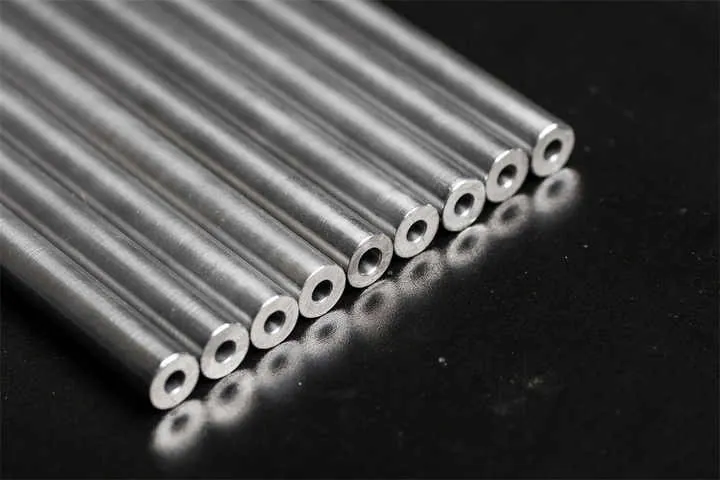
When I first managed billet preparation I learned that the exact target temperature depends on the alloy, size, and extrusion machine. For many common alloys like 6063 or 6061 in extrusion, one source says billets must be heated to about 800‑925 °F (roughly 427‑496 °C) before loading into the press. Another source gives a broader guideline of 400‑480 °C (750‑900 °F) as the starting point for extrusion heating.
Why this range? Because aluminum must be solid but plastic enough to flow through the die under pressure. If it’s too cold, the required force becomes huge and defects increase. If too hot, you risk oxidizing, melting, or altering the microstructure. One blog says billets are usually heated “around 420‑500 °C” to reduce flow stress and avoid cracks.
Here are some of the main factors influencing the target temperature:
Influencing factors
| Factor | How it affects the required temperature |
|---|---|
| Alloy type | Different alloys have different flow stress and temperature windows; heat‑treatable alloys may need tighter control. |
| Billet size & shape | Larger diameters take longer to heat uniformly; smaller ones heat faster but lose heat faster as well. |
| Press size & die complexity | Bigger presses or more complex dies may require higher billet temperature to maintain flow and avoid defects. |
| Time between furnace and press | If there is delay, billet cools; so higher temperature or shorter transfer time may be needed. |
Practical tip
I always set a target soak temperature slightly above the minimum required for ease of extrusion, then allow a short “settle” time so the core and surface of the billet reach equilibrium. Because as one research paper shows, the temperature distribution inside billets changes with time and geometry.
Key takeaway
You should aim to pre‑heat your aluminum billets to roughly 400‑500 °C (750‑930 °F) depending on alloy and conditions, then maintain them there until extrusion begins.
Billets for aluminum extrusion are typically heated to around 400‑500 °C before pressing.True
Multiple sources show this is the common temperature range for pre‑heating aluminum billets prior to extrusion.
Billets can be extruded cold without pre‑heating and achieve the same quality.False
Without pre‑heating the aluminum is too stiff, requiring excessive force and likely causing defects.
Why uniform heating is critical?
Imagine squeezing a hot chocolate bar that’s half melted and half frozen — it breaks unevenly. That’s what happens with uneven billet heating.
Uniform heating ensures the billet has consistent internal temperature so that deformation, surface finish and material properties remain consistent throughout the extrusion.

When I inspect extrusion billets I often ask: “Is the surface hot but the core still cool?” That is a common issue. According to a detailed study on aluminum extrusion billets, temperature gradients (differences between surface and center or between one end and the other) can impair process control.
In that study the authors note that radial gradients in typical billets are halved in tens of seconds and longitudinal gradients in hundreds of seconds. That means the interior can lag if heating or soak time is insufficient.
Consequences of non‑uniform heating
- The center may be cooler than the surface, increasing required force and causing internal defects like voids or cracks.
- The surface may be overheated relative to the core, causing surface pitting, oxidation, or grain boundary changes.
- Uneven temperature leads to uneven extrusion speed, wall thickness variation, dimensional inaccuracy.
- It may cause “cold zones” in the extruded profile which affect mechanical properties and finish.
How to achieve uniform heating
- Use a furnace with good circulation and uniform temperature zones.
- Ensure billets are spaced so heat flows evenly (not stacked too tightly).
- Provide sufficient soak time at target temperature to allow heat penetration.
- Minimize time between furnace and press to avoid cooling, especially at the ends or edges.
- Monitor temperature at different billet points to verify uniformity.
My experience
In one project we found the front end of a long billet was 20 °C cooler than the back end because it had sat in the loader longer. The extruded profile from that billet had subtle surface lines and lower yield strength. After adding a cover and shortening transfer time we restored uniformity and quality.
Temperature gradients inside a billet can lead to defects in extrusion.True
Research shows radial and longitudinal temperature differences affect extrusion outcome.
Only the surface temperature matters for extrusion quality; core temperature is irrelevant.False
The core temperature affects flow stress, internal defects, and final material properties, so it is relevant.
How to monitor billet temperature accurately?
You might think “I’ll just use a standard thermometer” — but in extrusion the stakes are higher and measurement is trickier.
Accurate billet temperature monitoring often uses non‑contact pyrometers or multi‑wavelength infrared sensors because aluminum’s emissivity changes and conventional contact thermocouples may not capture surface‑to‑core gradients.

When I set up our monitoring system I learned a few lessons: first, aluminum is reflective and its surface emissivity (ability to emit infrared) changes with oxidation, surface finish, and temperature. One company blog noted that above 500 °C (930 °F) the alloying elements in aluminum migrate and change surface emission behaviour.
Thus, if you rely on a single‑wavelength IR thermometer without calibration for emissivity changes, you may get inaccurate readings. Multi‑wavelength or ratio pyrometers are better suited.
Monitoring methods
| Method | Description |
|---|---|
| IR Pyrometer | Measures surface temp without contact. Fast, non-invasive. |
| Thermocouple | Contact sensor, accurate but invasive. Risk of surface damage. |
| Thermal Camera | Gives temp map of surface. Used more in R&D or troubleshooting. |
| Soak Time Model | Use heat transfer time models to infer uniform internal temp. |
My implementation tips
- Mark billet with timestamp after furnace exit.
- Use ratio pyrometers calibrated weekly.
- Reject billets that drop more than 10 °C below target before press.
- Always measure just before the loader, not earlier.
Non‑contact IR pyrometers are commonly used for billet temperature monitoring in extrusion.True
Industry sources recommend IR pyrometers especially for aluminum billets due to emissivity changes and hot surfaces.
A single surface temperature reading guarantees the entire billet is at uniform temperature.False
Surface reading does not guarantee core or end uniformity; internal gradients may still exist.
Can overheating damage billet quality?
Heating above target seems like “more safe” but actually it can invite a different set of risks — overcooking your billet like trying to bake a cake too long.
Yes — overheating of aluminum billets (for example above ~500 °C / 930 °F for too long) can lead to migration of alloying elements, surface changes, increased oxidation, and reduced material performance in the extruded profile.

I saw a case where a batch of billets sat too long in a furnace set at the high end of the range. They looked “glowing” at the surface and seemed fine, but the extrusion press had to push much harder, and the final parts showed reduced tensile strength. Why? Because the alloying elements had begun to migrate and the microstructure had changed.
Specific risks of overheating
- Alloy element migration: Can cause weak surface and non‑uniform mechanical properties.
- Oxidation: Leads to surface pitting and bad surface finish.
- Grain coarsening: Bigger grains reduce mechanical strength.
- Uneven cooling: Hot billets may lose more heat in parts, creating new thermal gradients.
- Die wear: Too hot billets shorten die lifespan.
My recommendation
I never let billet surface temps exceed 520 °C. I monitor furnace time closely. Anything above that for too long gets flagged for mechanical testing before use.
Heating a billet above target temperature for too long can degrade alloy properties.True
Sources indicate that above 500 °C alloying elements migrate and surface changes occur, which degrade properties.
Once a billet is overheated, it does not affect the extrusion process or final part quality.False
Overheated billets can cause increased defects, weaker mechanical properties, and surface finish issues.
Conclusion
In summary, I make sure our aluminum billets reach around 400‑500 °C (750‑930 °F) for optimal extrusion. I ensure uniform temperature so the whole billet is ready, use good monitoring tools to verify that, and avoid overheating above ~500 °C for long periods. Doing this helps ensure smooth extrusion operations, high‑quality profiles, and fewer headaches down the line.


