What Is the Use of T?slot Aluminum Profile?
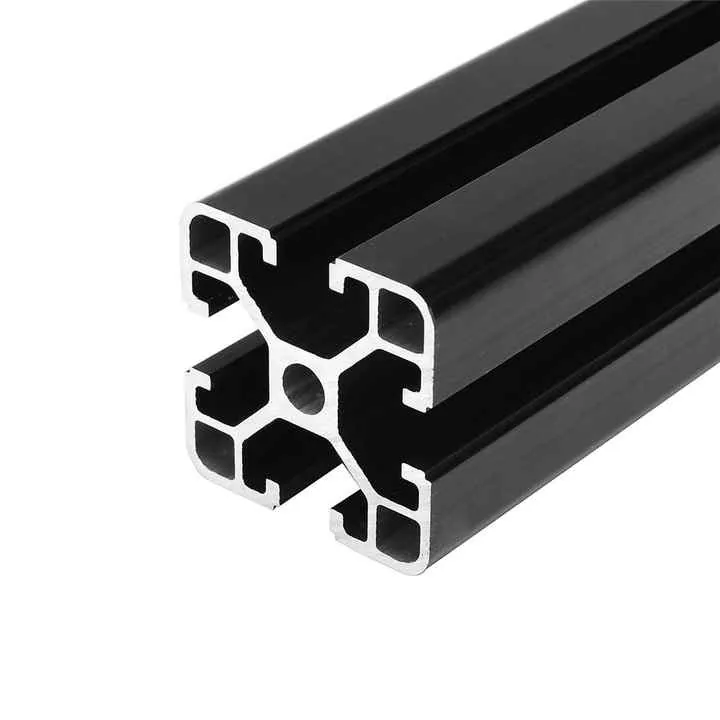
I often see engineers choose T?slot aluminum profiles for frames and structures. They value strong joints without welding.
T?slot profiles serve as building blocks for machine frames, workstations, robotics, and shelving—letting you assemble and adjust easily.
What applications use T?slot aluminum profiles?
I’ve built lab benches, conveyor frames, and 3D printer enclosures using these profiles. They fit many applications.
Common uses include:
- Industrial machine frames – support heavy equipment with bolted joints
- Workstations & benches – configure shelves and panels rapidly
- Robotics & automation systems – mount motors, actuators flexibly
- Safety guards and enclosures – secure transparent panels simply
- 3D print and CNC frames – gain rigidity without welding
- Custom retail fixtures – build adjustable displays and racks
How do they simplify assembly processes?
I once assembled a production line frame in hours without welding. Instead, I used T?nuts, bolts, and linear connectors.
T?slot systems let you bolt pieces together to build modular structures with high precision and easy re-configuration.
Key benefits:
- Modular design – build frames piece by piece
- Tool-free changes – slide nuts, tighten bolts to reposition
- No welding heat – no warping, no post-treatment
- Fast assembly – standard connectors and corner brackets
- Precision alignment – use joining plates, angle brackets
Featured example:
| Feature | Benefit |
|---|---|
| Sliding T-nuts | Moveable anchor for flexible attachment |
| Corner brackets | Square and strong 90° joints |
| Joiner plates | Distribute load across wide sections |
| End caps | Clean finish, protect edges |
I reconfigured a test rig in under an hour by loosening corner bolts, repositioning, then re-tightening. No drilling or welding required.
Can T?slot profiles be customized?
Yes—I’ve ordered bespoke profiles with extra grooves or pockets for wiring and lighting.
You can customize alloy, cross-section shape, lengths, and special machining before delivery.
Custom options typically include:
- Length cutting – from a few cm to 6 m segments
- Special cross-sections – add internal ribs, channels for cables
- Hole locations – pre-drilled holes, tapped holes in custom positions
- Surface finish – anodizing, powder coating, brushed, or polished
- CNC machining – slots, cutouts, end-face machined interfaces
- T-slot width and shape – match metric or imperial hardware
What accessories work with T?slot systems?
I keep a range of T-nuts, brackets, hinges, and handles that snap right onto the slots.
Common accessory types:
- T-nuts & sliding nuts – anchor bolts anywhere along slot
- Connector plates & corner brackets – build 90°, T and X joins
- Joining blocks – strong internal connectors for angular joints
- Gussets – strengthen high-load corners
- End caps and covers – improve safety and aesthetics
- Panel nuts, handles, hinges – add enclosure features
- Linear rails & guides – mount on T-slot for automation
- Cable carriers & routing clips – organize wires on profiles
- Specialized hardware – drop-in hinges, cam locks, swivel joints
Example accessory table:
| Accessory | Purpose |
|---|---|
| T-nut (sliding) | Grip inside slot, secure bolt/remove as needed |
| Corner bracket | Clamp two profiles at 90° firmly |
| Joining plate | Reinforce long straight joints |
| Panel nut | Attach panels securely without welding |
| Linear rail | Add motion systems to profile structures |
| End cap | Protect slots and give finished look |
Conclusion
T?slot aluminum profiles are versatile building blocks. They are used across industries—industrial machinery, automation, lab setups, retail fixtures, and DIY projects.
They speed up assembly, require no welding, and allow easy reconfiguration. You can customize profiles and use many accessories like nuts, brackets, panels, and linear guides.
This modular system saves time, money, and offers flexible, adjustable construction options.