How Much Weight Can Aluminum Extrusion Hold?
I once faced a scenario where an aluminum frame sagged under a heavy load and I wondered—how much weight can aluminum extrusion truly hold?
The load‑capacity of an aluminum extrusion depends on alloy grade, profile geometry, support conditions, and connection design—there’s no single “how much” figure that applies universally.
Now I’ll walk through the key factors, the geometry side, calculation methods, and how reinforcements help. This gives you a clear view of how to judge load limits for your aluminum‑extruded solution.
What affects extrusion load capacity?
Imagine you pick a profile and hang a heavy item—if you didn’t account for everything, failure may happen.
Load capacity is influenced by the material alloy (e.g., 6063‑T5 or 6061‑T6), the length and orientation of the span, how the profile is supported, and how it connects to other parts.
I’ve learned that you cannot treat aluminum extrusion like a fixed generic beam. Many factors change how much weight it can safely support.
材料の合金と焼入れ状態
The alloy matters. For example, 6063‑T6 has a yield strength around 31,000 psi and tensile around 35,000 psi, while simpler alloys like 1100 may have yield strengths under 5,000 psi.
That means if you pick a weak alloy, your allowable load drops significantly.
Length and support conditions
An extrusion that is 500mm long and supported both ends will handle far more load (or deflect less) than a 2000mm cantilevered span. For example, a 45×45 profile at 500 mm span might handle hundreds of newtons; at 2000 mm it might only handle tens of newtons.
Span (L) is inversely related to allowable load and deflection.
Cross‑section and geometry
A profile with larger moment of inertia (I) or section modulus (W) resists bending much better. A thick‑walled, large cross‑section profile will hold more than a thin, small profile.
Also wall thickness, symmetry of section, and presence of hollow vs solid shapes matter. Uneven wall thickness can lead to distortion under load.
Connections and fixing
Even the best profile fails if its connections are weak. In T‑slot framing systems the connection (brackets, fasteners) often becomes the weak link—not the extrusion itself.
Fixed ends give better load capacity than simply supported or cantilever ends.
Poorly assembled frames with loose fasteners or misalignment also reduce capacity.
Environment & dynamic loads
Vibration, cyclic or pulsating loads reduce allowable limits. Some tables assume maximum bending tension of 100 N/mm² for static loads, but only 30 N/mm² for alternating loads.
Temperature, corrosion, fabrication (cuts, holes) can also reduce strength.
Summary table of factors
| ファクター | なぜそれが重要なのか |
|---|---|
| 合金と焼入れ | Lower yield/tensile strength → lower allowable load |
| Length/span & support | Longer spans produce greater bending and deflection |
| Cross‑section geometry | Higher moment of inertia/resistance improves capacity |
| Fixing/connection design | Weak joints reduce effective strength of system |
| Loading type & environment | Dynamic loads, corrosion, temperature weaken capacity |
Alloy grade is the only thing that determines how much weight an aluminum extrusion can hold.偽
Other factors like geometry, span, support conditions and connection design also play a significant role.
A shorter span extrusion supported at both ends will hold more load than a longer cantilevered one of the same alloy and cross‐section.真
Because bending moments and deflection increase with span length and weaker support conditions, the shorter supported span handles more load.
Why does profile geometry matter?

If you just pick a “20×20 aluminium profile” without checking its shape, you might end up with a sagging beam.
Geometry matters because the shape determines the moment of inertia and section modulus, which in turn determine how much bending stress and deflection under load the profile will experience.
Let’s examine more deeply how geometry influences load capacity in practical terms.
Moment of inertia and bending capacity
When a beam is loaded, bending stress ( \sigma = \frac{M}{W} ). A higher section modulus means less bending stress.
If you double the height of a rectangular section but keep thickness the same, moment of inertia increases by ~4×, improving bending resistance.
Wall thickness and hollow vs solid
A thicker wall gives better strength and less deflection. Hollow sections reduce weight but may reduce stiffness unless optimized.
Consistent wall thickness is key—variations cause distortion under load or heat.
Span and shape orientation
Profile orientation matters: a 40×80 profile loaded vertically (80 upright) is stiffer than the other way.
Deflection increases with cube of span: (\delta = \frac{P L^3}{48 E I}).
So long spans suffer more deflection, even if the material stays the same.
Fixing condition and profile end treatment
Fixed ends reduce deflection more than simple supports.
Cantilevered beams deflect more:
- Cantilever: ( \delta = \frac{P L^3}{3 E I} )
- Simply supported: ( \delta = \frac{P L^3}{48 E I} )
Practical selection using tables
For example, a 40×80 profile may allow ~554 N load at 500 mm span with deflection limit L/1000.
Same profile at 2000 mm span may only support ~57 N.
This shows why geometry and span are more influential than just material strength.
An extrusion with very thin walls but large external dimensions will always hold as much as a thick‑walled smaller extrusion.偽
Although external dimensions contribute, thin walls reduce moment of inertia and stiffness; a small but thick‑walled extrusion can outperform a large thin‑walled one for load.
Deflection increases with the cube of the span length for a simple supported beam under central load.真
According to the formula δ = P L³/(48 E I), deflection is proportional to L³.
How to calculate safe load limits?

When a client asked me to specify allowable load for a custom aluminum frame, I used formulas rather than guessing.
Safe load limit calculation typically uses beam bending and deflection formulas—choosing allowable deflection (often L/1000), then solving for allowable load P using P = (constant × E × I × deflection)/(L³), plus checking stress = M/W < yield strength.
Let me walk through how I calculate safe load limits for aluminum extrusions.
ステップ・バイ・ステップ方式
- Define span and support condition (e.g., cantilever, simply supported, fixed).
- Select alloy and get yield strength, E modulus (typically ~70,000 N/mm²).
- Get cross‑section properties: moment of inertia (I), section modulus (W).
- Set allowable deflection: typically L/1000.
- Compute allowable load using:
[
\delta = \frac{P L^3}{48 E I} \quad → \quad P = \frac{48 E I \delta}{L^3}
] - Check bending stress: ( \sigma = M / W = (P L / 4) / W )
- Apply safety factor: typically 2×
- Check for buckling, torsion, and connection strength
例
500 mm span, I = 15,000 mm⁴, δ_max = 0.5 mm:
[
P = \frac{48 × 70,000 × 15,000 × 0.5}{500^3} ≈ 201.6 N ≈ 20.6 kg
]
Check stress: ( M = 201.6 × 125 = 25,200 N·mm ), W = 1,500 mm³
[
\sigma = 25,200 / 1,500 = 16.8 MPa )
]
Well below 100 MPa allowable (assuming FS=2 and yield 200 MPa).
Manufacturer tables
Example: 20×20 profile at 500 mm span → ~94 N (≈10 kg) for L/1000 deflection.
Use calculators from 8020.net or Vention for quick estimates, but always check assumptions.
You can calculate safe load by only checking the material yield strength, ignoring deflection.偽
Deflection often controls design in aluminum extrusions for stiffness rather than just yield strength; bending and deflection formulas are required.
Using a manufacturer table that assumes maximum deflection of L/1000 gives a conservative safe load for many static applications.真
Many tables define allowable load to cause a deflection of L/1000, which provides a conservative baseline for static loads.
Can reinforcements increase load strength?
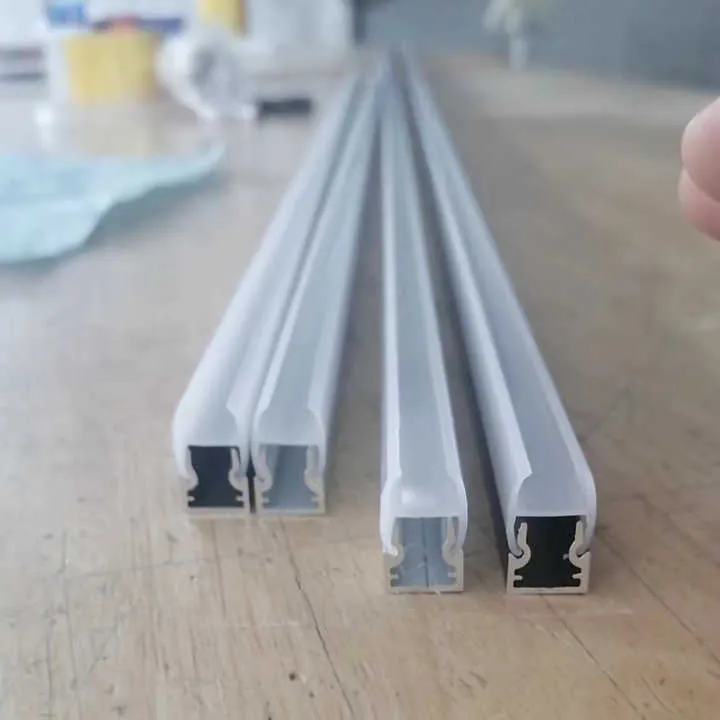
I once strengthened a lightweight aluminum frame by adding internal webs and braces—and load capacity jumped.
Yes—reinforcements such as thicker wall sections, internal stiffening ribs, bracing, doubling profiles, and using higher‑strength alloy all can increase the load strength of an aluminum extrusion system.
Let’s explore how reinforcing an aluminum extrusion structure improves its load performance.
Strategies for reinforcement
- Use thicker walls or larger cross‑sections
- Add internal stiffeners or ribs
- Include cross‑bracing to reduce effective span
- Combine profiles in parallel (e.g., sandwich method)
- Use stronger alloy (e.g., 6061‑T6 instead of 6063‑T5)
- Strengthen joints and connections
- Add intermediate supports to reduce span
When reinforcement helps
- For heavy loads
- For long spans
- For dynamic/cyclic loads
- For high stiffness requirements
- For reducing deflection below strict limits
トレードオフ
Reinforcement adds cost, complexity, and weight.
Custom profiles cost more than standard ones.
Overbuilt joints are safer but require stronger fasteners or welding.
More bracing may require more space and planning.
Reinforcement Effect Table
| Reinforcement method | 主なメリット | Trade‑off |
|---|---|---|
| Thicker/larger profile | Higher stiffness & strength | More cost & weight |
| Internal stiffener/web | Stronger for same size | Often custom & costly |
| Bracing/cross‑members | Shorter effective span | More parts, design effort |
| Higher alloy/temper | Greater strength | May increase machining difficulty |
| Doubling profiles | Much higher I & W | Requires careful connection design |
Adding diagonal bracing to reduce unsupported span in a frame increases the load capacity of aluminum extrusions.真
Because bracing reduces the effective span (L) and therefore reduces bending moment and deflection, improving capacity.
Using a larger cross‐section profile always means you don’t need to worry about the connections.偽
Even large cross‐section profiles fail if connections are weak; the whole load path matters.
結論
In my experience designing aluminum extrusion solutions, I found that while you cannot quote a single “weight” number, you absolutely can determine safe load by considering alloy, geometry, span/support conditions, and design of connections. Then, if you need more strength, you can reinforce intelligently. With that approach you can confidently design or choose profiles suited for your load needs.