Aluminum extrusion cooling channel design options?

Hot spots, uneven cooling, and pressure drops can turn a good product into a warranty problem. When cooling channels are an afterthought, the system usually pays the price in noise, leaks, and low efficiency.
Aluminum extrusion gives many practical cooling channel design options, from simple bores to complex multi-pass paths. The best option balances flow, heat transfer, cleanability, sealing, and cost, not just one metric.
The goal is simple: move heat fast and predictably, while keeping manufacturing and maintenance under control. The sections below break down the channel shapes, how internal passages are made, when multi-pass helps, and how to seal the whole thing with fewer surprises.
What channel geometries optimize coolant flow?
Bad geometry creates two common failures: high pressure drop and dead zones. High pressure drop wastes pump power. Dead zones trap warm fluid and cut heat transfer. A good channel shape avoids both, while staying realistic for extrusion and cleaning.
The best coolant channel geometries keep velocity more even, reduce sharp turns, and increase wetted perimeter without creating hard-to-clean pockets. Round and smooth racetrack shapes are often the safest baseline, while carefully designed multi-lobe or pin-like shapes can boost heat transfer when fouling risk is low.

Start with what the pump "feels"
Flow does not care about marketing claims. It cares about friction and turns.
- Round channels are predictable. They have low pressure loss for a given area and are easy to flush.
- Racetrack (rounded rectangle) often fits better in thin walls while keeping smooth corners.
- Sharp rectangles can create low-velocity corners. Those corners become sludge pockets in real coolant loops.
- Serpentine paths can raise velocity and heat transfer, but every bend adds loss and can trap bubbles.
Heat transfer is not only about area
Many teams chase surface area and forget cleanability.
- More perimeter can help heat transfer.
- But micro-features can foul fast.
- A slightly simpler shape that stays clean can outperform a fancy shape after six months.
Geometry rules that usually work
The following rules of thumb help early decisions:
- Kasutage rounded corners everywhere you can.
- Avoid sudden expansions ja sudden contractions.
- Keep bends gentle (bigger bend radius).
- Keep channel sizes large enough for flushing and for expected particle load.
Practical geometry comparison
The table below is a quick guide for early screening.
| Kanali geomeetria | Flow behavior | Heat transfer potential | Fouling risk | Notes for extrusion and use |
|---|---|---|---|---|
| Ümmargune | Very stable, low loss | Keskmine | Madal | Easiest to predict and clean |
| Racetrack | Stable, moderate loss | Keskmine kuni kõrge | Madal kuni keskmine | Good for thin profiles |
| Rectangle (sharp) | Corner dead zones | Keskmine | Keskmine kuni kõrge | Avoid unless corners are radiused |
| Multi-lobe | Can disrupt boundary layer | Kõrge | Keskmine | Works best with clean coolant |
| Small pin-like features | High mixing | Väga kõrge | Kõrge | Only for filtered systems |
Rounded corners in a cooling channel usually reduce pressure drop and lower the chance of sludge pockets.Tõsi
Rounded corners reduce separation and corner dead zones, so flow stays more even and debris has fewer places to settle.
Sharp rectangular channels always provide the best thermal performance because they maximize area.Vale
Sharp corners often create low-velocity zones that foul and reduce effective heat transfer over time.
How does extrusion enable internal cooling passages?
Many people picture extrusion as a simple outer shape. In practice, extrusion can create internal voids and passages in one step, as long as the die can support it and the metal flow stays balanced.
Extrusion enables internal cooling passages by using hollow dies with mandrels and bridges that shape internal voids during the press stroke. With proper die support, metal flow control, and post-extrusion finishing, internal channels can be made repeatably without drilling long paths.

The core idea: a hollow die forms the void
To create an internal passage, the die must hold a mandrel in place. The mandrel is supported by bridges (also called webs). Aluminum flows around those supports and then merges in a welding chamber before exiting.
This creates two realities that matter for cooling channels:
- The internal channel shape is possible, but it must be die-feasible.
- The profile has weld seams where metal streams reunite, and those seams must be placed smartly.
What controls whether a channel is feasible
Several factors decide whether the channel can be extruded with good yield.
Metalli voolu tasakaal
If one side of the profile flows faster, walls get thin and channels can distort. Balanced wall thickness and symmetric features help.
Bearing design and friction
Die bearings control exit speed. A well-tuned bearing can make internal webs and outer walls exit together, reducing twist and taper.
Minimum wall thickness and web strength
Very thin internal walls can collapse during extrusion or later during handling. For cooling channels, thin walls also risk corrosion and erosion if coolant is aggressive.
Post-processing options
Extruded channels often need finishing steps to become a reliable cooling component:
- Venitus sirgendamine to reduce twist.
- CNC-töötlemine for ports, manifolds, and sealing faces.
- Koorimispunktide eemaldamine at port intersections.
- Pinnatöötlus like anodizing or coating when corrosion risk is high.
Design habits that reduce production risk
When designing internal passages, these habits usually help:
- Keep internal features simple and smooth.
- Avoid extreme differences in wall thickness in the same cross-section.
- Plan port locations so weld seams do not sit on the highest stress sealing faces.
Hollow extrusion dies can form internal channels using a mandrel supported by bridges, creating a one-step internal passage.Tõsi
In hollow extrusion, the mandrel shapes the void while bridges support it, and aluminum flows around the supports to form the internal cavity.
Extrusion cannot create internal cooling channels, so drilling is always required.Vale
Extrusion can create internal passages directly when a hollow die is used and the design is die-feasible.
Can multi-pass channels improve thermal efficiency?
A single straight pass can be enough for low heat loads. But when the heat flux is high or the footprint is tight, multi-pass designs become attractive. The question is whether the added complexity pays off in real systems.
Multi-pass channels can improve thermal efficiency by increasing coolant residence time, raising average velocity over hot zones, and reducing temperature rise mismatch across the part. They work best when pressure drop, air purge, and cleaning are designed in from the start.

Why multi-pass can help
A multi-pass channel routes coolant across the hot area more than once. That can help in three ways:
- More uniform temperature: The coolant is forced to sweep areas that a single pass might miss.
- Higher local velocity: Splitting flow into narrower passes can raise velocity and heat transfer coefficient.
- Better use of limited length: If the part is short, a serpentine path adds effective flow length.
The real cost: pressure drop and pump power
Every turn and extra length adds friction loss. If pump power grows too much, the system may run hotter overall because the flow rate drops. It is a trade.
A useful way to think about it:
- If the system can afford more pressure drop, multi-pass can be a win.
- If the pump is already near its limit, multi-pass can backfire.
Air purge and bubble traps
Multi-pass layouts often create high points that trap air. Trapped air reduces cooling and can cause noise. A good design includes:
- A clear fill and bleed strategy.
- Slopes or routing that guides air to vents.
- Avoiding sudden high points near tight turns.
Cleanability and service life
In industrial coolant loops, fine particles and additives build films. Multi-pass channels are harder to clean if they include tight turns or narrow sections. Filters help, but design still matters.
Multi-pass patterns to consider
Common layouts include:
- Serpentiin: One continuous path with U-turns. Simple plumbing, higher pressure drop.
- Parallel multi-pass: Several channels in parallel fed by manifolds. Lower pressure drop, but needs balanced distribution.
- Hybrid: Short parallel legs with mild turns, aiming for both uniformity and manageable loss.
When multi-pass is worth it
Multi-pass is usually worth the extra work when:
- Hot spots are severe and localized.
- The cooling footprint is limited.
- A slightly higher pump power is acceptable.
- The coolant is filtered and maintenance is planned.
Multi-pass channels can improve temperature uniformity by forcing coolant to sweep hot zones more evenly.Tõsi
Routing the flow across the heat source multiple times can reduce local hot spots and even out the part temperature.
Multi-pass channels always reduce pressure drop because the flow is guided more carefully.Vale
Multi-pass paths usually increase pressure drop due to added length and bends, which add friction and minor losses.
Which sealing methods suit extruded cooling channels?
A cooling channel is only as good as its seals. A small leak can ruin electronics, cause corrosion, or create safety hazards. Sealing choices should match pressure, temperature cycles, coolant chemistry, and assembly style.
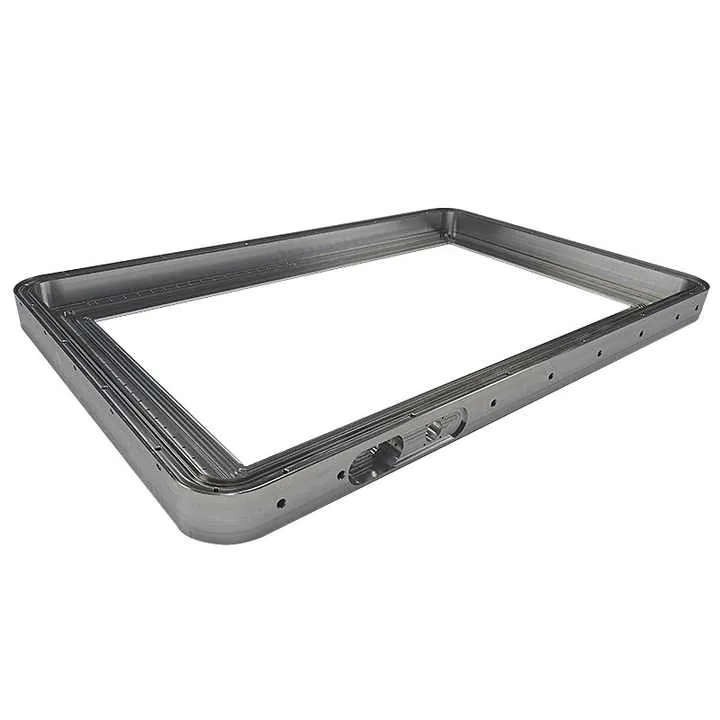
Sealing methods for extruded cooling channels commonly include O-rings in machined grooves, face gaskets, brazed or welded closures, and mechanical end caps. The best choice depends on serviceability needs, tolerance control, and whether the channel is meant to be opened for cleaning.
O-rings: the most common serviceable option
O-rings work well when:
- The mating faces are flat and controlled.
- Groove dimensions are consistent.
- Compression is correct and repeatable.
O-rings are strong for maintenance because the channel can be opened, cleaned, and resealed.
Gaskets: good for large faces and lower pressure
Gaskets can tolerate minor surface variation and cover larger areas. They work best when:
- Pressure is moderate.
- Bolt load is uniform.
- Coolant is compatible with gasket material.
Permanent seals: brazing or welding
If the channel should never be opened, permanent closure can reduce leak risk.
- Jootmine can seal covers and end plates with a continuous joint.
- Keevitamine can be strong but may distort thin walls and requires good process control.
Permanent seals are common when the part is sealed for life and service access is not needed.
Mechanical end caps and plugs
End caps are useful for straight-through channels where the ends are accessible. They can be:
- Press-fit plugs
- Threaded plugs
- Clamped end caps with a gasket or O-ring
Sealing selection checklist
The table below helps match sealing method to typical use conditions.
| Tihendusmeetod | Parimad selleks, et | Serviceable | Typical risk | Simple mitigation |
|---|---|---|---|---|
| O-ring in groove | Medium to high pressure, repeated assembly | Jah | Wrong squeeze or poor surface | Control groove, specify finish |
| Flat gasket | Large faces, moderate pressure | Jah | Uneven bolt load | Use stiff cover, good bolt pattern |
| Brazed cover/end | High reliability, sealed-for-life | Ei | Process voids | Qualified brazing process |
| Welded closure | High strength needs | Ei | Distortion, porosity | Fixturing and weld procedure |
| Threaded plug | Straight bores, access at ends | Jah | Loosening, leak paths | Thread sealant, torque control |
Tolerance and surface finish matter more than the seal brand
Many leaks blamed on "bad seals" are really caused by:
- Out-of-flat faces
- Tool marks crossing the seal path
- Misaligned bolt patterns
- Uneven compression from warped covers
For extruded cooling channels, it helps to machine the sealing land in one setup, then inspect flatness and roughness. A simple inspection routine saves rework later.
O-rings are often a good choice for extruded cooling channels when the design needs service access and repeatable assembly.Tõsi
O-rings can seal well with controlled grooves and allow disassembly for cleaning or repair.
Brazed or welded seals are always better than O-rings because permanent joints can never leak.Vale
Permanent joints can still leak due to porosity, distortion, or process defects, and they remove service access for cleaning or repair.
Kokkuvõte
Good cooling channels come from balanced choices: geometry that flows well, extrusion-friendly internal passages, multi-pass only when the pump and maintenance plan support it, and sealing that matches real service conditions.