


How are hollow aluminum extrusions made?

I once faced the challenge of designing a hollow aluminum profile and realised how the manufacturing process itself can make or break it.
Hollow aluminum extrusions are made by forcing a pre‑heated billet through specialised tooling (dies, mandrels, bridges) so that internal cavities form while the aluminium flows and welds around supports.
Now I will walk you through key questions step by step — what tooling is used, how the internal bridges and mandrels work, how to maintain a uniform wall thickness, and how cooling influences the result.
What tooling creates hollow profiles?
Imagine the aluminium like play‑dough being squeezed through a strange shape. We worry: if the tooling isn’t right the cavity won’t form or the walls will be uneven.
The tooling for hollow profiles uses hollow dies (often called porthole or bridge dies) plus mandrels and supports, enabling the aluminium to flow and join around internal voids to form the hollow cross section.
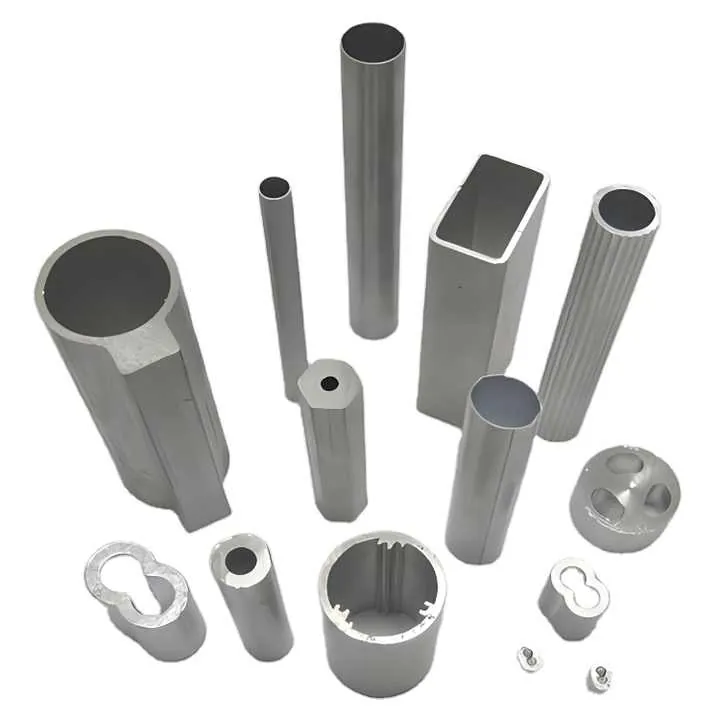
To produce a hollow aluminium profile you cannot simply push the billet through a flat die. According to the technical overview, hollow dies consist of several parts: a mandrel that defines the void, a die cap or plate that defines the outer contour, legs or bridges to support the mandrel, and backing/support tooling to bear the pressure.
For example, in a “porthole” die, the aluminium flows into the die, splits around the mandrel supports (“legs”), then rejoins after the weld chamber before exiting as a hollow section.
The tooling stack also includes the die ring, backing plate (or backer), bolster and sometimes sub‑bolster to deliver the high pressures (thousands of tons) and maintain alignment and thermal stability.
Here is a simplified table of components and their purpose:
| Tool component | الغرض |
|---|---|
| Mandrel | Creates the internal cavity/void |
| Die cap / die plate | Shapes the outside of the profile |
| Bridges / legs | Support mandrel, allow flow around them |
| Backer / bolster | Provide structural support and alignment under pressure |
| Dummy block / container | Hold and deliver the billet under high pressure |
In practice, when designing hollow sections for extrusion you must account for the tooling complexity (cost, die life, maintenance) and the material flow behaviour. The more cavities or the thinner walls, the more challenging the tooling becomes. Also the tooling must handle the high thermal and mechanical stress of the extrusion process.
Hollow aluminium extrusions can be made using the same tooling as solid profile extrusions without modification.خطأ
Hollow profiles require specialised tooling (mandrel, bridges, porthole die) not used for solid profiles.
A porthole die uses a mandrel and legs to form an internal void in the extrusion.صحيح
In hollow die systems the mandrel defines the void and legs/bridges support it; aluminium flows around this and welds back together.
Why bridges and mandrels form hollow sections?
You might think the cavity is simply formed by pulling out a pin, but in practice the aluminium must flow around supports and rejoin — otherwise the part will have weak weld lines or collapse.
Bridges (or legs) and mandrels create the internal void by guiding aluminium flow around the cavity supports, ensuring the metal fuses behind the supports to form a continuous hollow section.
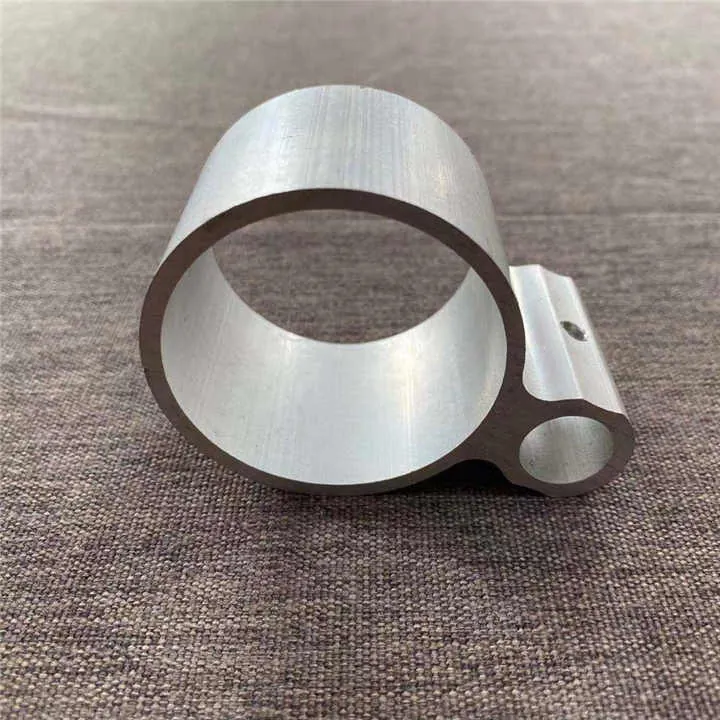
When extruding a hollow aluminium profile, the tooling must allow the material to flow around something that keeps the internal void open — that is the mandrel — while also providing structural support so that the die can withstand pressure. The bridges or legs are that support system. For example, the extruded aluminium splits, flows around both sides of the mandrel supports (legs), then merges in the “welding chamber” before exiting.
Why is that necessary? If you tried to simply have a void with no supports, the die would not physically hold itself under load, or the aluminium might collapse the cavity. Bridges maintain geometry. The mandrel defines the internal shape. Also the rejoining (or welding) of separate flow streams is necessary so the final profile is a solid continuous metal shell, not two halves that don’t fuse.
There are multiple types of hollow tooling: porthole, spider, bridge and floating mandrel systems. The selection depends on size, alloy, profile complexity and equipment.
In designing for hollow profiles, you must keep in mind that the presence of legs/bridges means there will often be weld lines (the point where the metal streams rejoin) and possibly variations in material properties. Tooling design (bridge geometry, weld chamber height, mandrel alignment) influences flow balance and thickness uniformity. For example, research found that altering the port bridge structure and welding chamber height in a porthole die improved wall thickness variation and speed of extrusion.
From my own experience working with aluminium extruders, the more cavities or more complex the internal shape, the more careful the mandrel/bridge design must be. It also influences the cost and lead time of the tooling. If you are specifying custom hollow profiles, you must communicate the required internal void size, number of internal webs, wall thickness tolerances and alloy to your extrusion supplier so that the correct mandrel/bridge tooling is designed.
Bridges or legs in a hollow die serve purely aesthetic purposes.خطأ
Bridges and legs are functional: they support the mandrel and guide material flow around the void to form the hollow section.
The mandrel in a hollow die forms the internal cavity by defining the void around which material flows.صحيح
The mandrel defines internal contour; aluminium flows around it and exits as the hollow section.
How to maintain uniform wall thickness?
If you don’t control wall thickness you end up with weak sections, warping or rejected parts — so thickness uniformity is vital.
Uniform wall thickness in aluminium extruded hollows is achieved by optimising tooling design (bearing lengths, flow channels), balancing metal flow, and avoiding abrupt thickness changes.
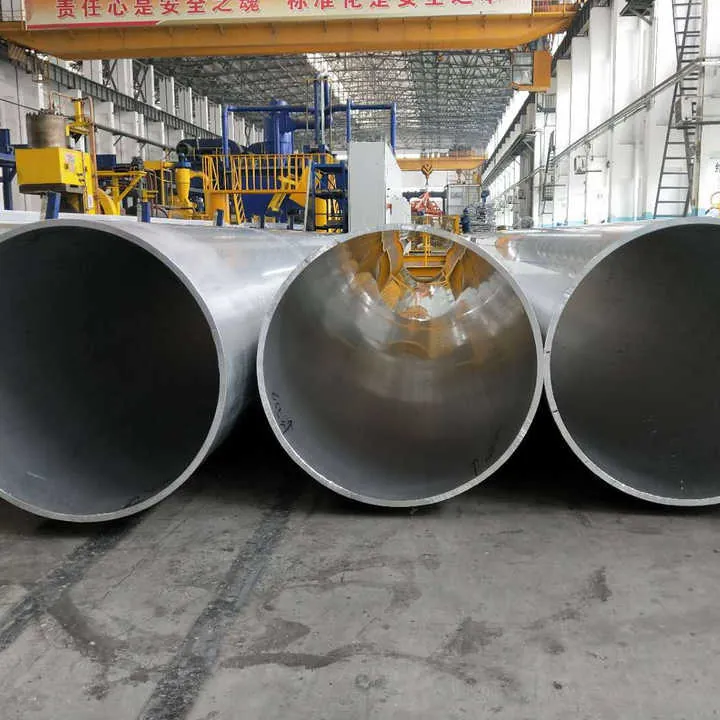
Maintaining uniform wall thickness is one of the most important quality factors in extruded hollow aluminium profiles. Uneven thickness leads to cooling distortion, weak spots, and problematic assembly. Several guidelines exist:
Key factors influencing wall thickness uniformity:
- ميزان التدفق المعدني
- Wall thickness transition
- Profile symmetry
- Die design – bearing length, land length
- Cooling and extraction
Practical recommendations:
| التوصية | ما أهمية ذلك |
|---|---|
| Avoid abrupt thickness changes | Thinner walls cool faster → distortion |
| Maintain thickness ratio under ~2:1 | Improves machinability and extrusion stability |
| Use generous radii at transitions | Helps flow and reduces stress concentrations |
| Keep profile symmetry where possible | Balanced flow and cooling lead to better uniformity |
| Collaborate early with tooling designer | Tooling decisions affect wall thickness outcomes |
From my personal story: when I worked on a hollow frame profile, early prototypes had walls varying by ±0.3 mm across long spans. By redesigning the tool bearing length and adding flow‑feed features, we reduced variation to ±0.1 mm and dramatically improved yield.
Machine cooling rate does not affect wall thickness uniformity in aluminium extrusion.خطأ
Cooling rate affects how sections shrink and solidify; unequal cooling leads to thickness variation and distortion.
Keeping transitions between thick and thin sections gradual helps maintain wall thickness uniformity.صحيح
Gradual transitions improve flow balance and cooling uniformity, reducing thickness variation.
Can cooling affect hollow extrusion quality?
Even if tooling and design are perfect, poor cooling after extrusion can still ruin a hollow profile — warping, distortion or internal void may result.
Yes — cooling affects hollow extrusion quality significantly: rapid or uneven cooling of hollow profiles can cause distortion, internal stresses and variations in internal cavity geometry and wall thickness.

Right after the aluminium profile exits the die it is still hot and malleable. The cooling phase determines how the metal solidifies, its residual stresses, straightness, and dimensional accuracy. For hollow extrusions, this phase is critical because internal voids mean there is less mass in certain parts, and thus different cooling behaviour compared to solid sections.
Cooling factors and their effects:
- Quenching or air cooling
- Different thicknesses = different cooling rates
- Hollow cavity effect
- Cooling flow uniformity
- Stretching after cooling
From my observations: In one run with a large hollow profile (≈400mm wide) we found end‑to‑end bowing because the far side of the profile cooled slower (due to spray pattern) and contracted later than the near side. We corrected by adjusting the quench water nozzles and adding a gentle air blower on the far side. The result: bow reduced by 70%.
So, when you specify hollow aluminium extrusions in your project (for example your company’s large aluminium extrusions for construction), you should ask your manufacturer:
- How is the cooling/quench station arranged for the profile size and hollow geometry?
- Is air/water flow balanced around the part?
- How do they control temperature variation across the section?
- What stretch‑straightening is used post cooling?
Cooling has no impact on the straightness or dimensional accuracy of hollow extruded aluminium profiles.خطأ
Uneven cooling leads to differential shrinkage, distortion, bowing or twist in extruded profiles, particularly hollow ones.
Proper quenching and uniform cooling contribute significantly to maintaining wall thickness uniformity and profile geometry in hollow aluminium extrusions.صحيح
Uniform cooling helps avoid differential shrinkage and maintains geometry and thickness consistency.
الخاتمة
In my view, making hollow aluminium extrusions is a highly integrated process: the tooling (die, mandrel, bridges), profile design (wall thickness transitions, symmetry), and post‑extrusion cooling/stretching all must be tuned. If you control those, you will achieve hollow profiles that meet tight tolerances and quality requirements.


